LET’S GO
Be yourself; Everyone else is already taken.
— Oscar Wilde.
This is the first post on my new blog. I’m just getting this new blog going, so stay tuned for more. Subscribe below to get notified when I post new updates.
Be yourself; Everyone else is already taken.
— Oscar Wilde.
This is the first post on my new blog. I’m just getting this new blog going, so stay tuned for more. Subscribe below to get notified when I post new updates.
What I did
Today we started a new practical production module is to explore media production techniques in journalism, public relations, and events management. From this session I would be able to utilise and demonstrate basic media production skills in each sector through commitment to my own learning and engagement with the course content.
The task that we were set to find an example of an event or exhibition that is taking place or an event or exhibition that is advertised. The questions that we were asked were:
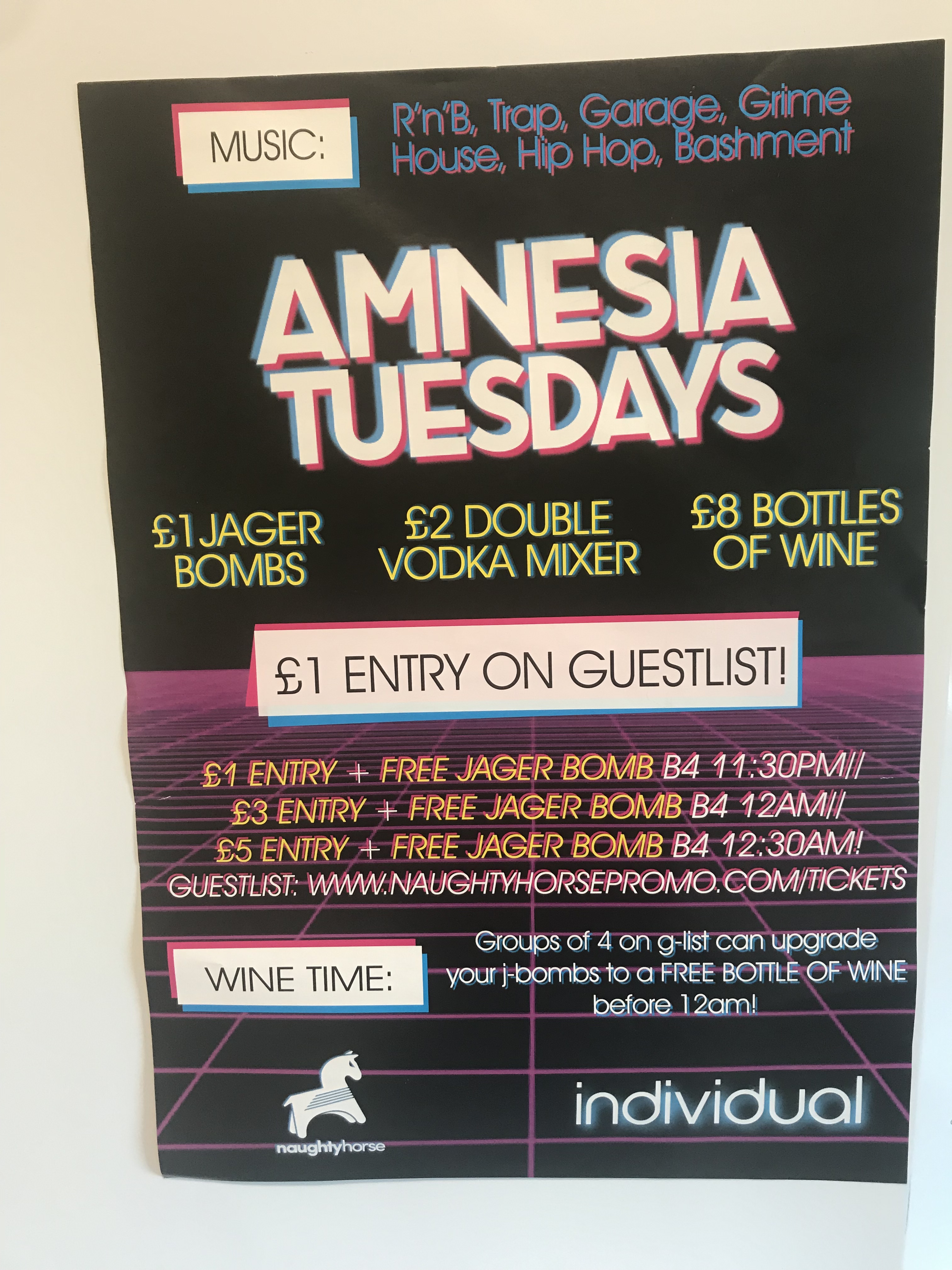
What I used as an example was a poster that I saw which was for an event happening in the club ‘Individual’ located in Arcadian on Tuesday. The purpose of this poster was to inform students of deals as it was for freshers’ week. The intentions of the poster is to lure students to the low prices and music as they were playing music suited for our age group. They also did offers for guest list which meant you would only need to pay £1 entry and you also get a free jaeger bomb drink. The demographic was obvious as you could tell from the location and the price. The club is in an area which is surrounded by clubs which means the area is made for partying. Furthermore, the price of the entry is very low. This shows that it is for the students as you wouldn’t expect adults to not be able to afford the standard price.
What I did
Today I learnt the basics on how to use adobe audition. Adobe Audition is a professional audio editing application that includes a non-destructive mixing and editing environment, as well as a destructive waveform editing mode. Adobe Audition can be used for: Recording and mixing sound projects. Creating original or remixed music. I hope to use this programme for my radio edit in the future.
What did I learn
One of the things that we learnt in the session was bleeding audio. Bleeding audio is when audio is too loud or is in the red section of the volume. This means that when you play the audio you can hear other sounds such as white noise which happens when the mic is too loud. To fix this problem one thing you could try is noise reduction which is located in ‘Effects’ and then in modulation you need to select the part which you want to eliminate. This then captures the noise print. When capturing a noise print you would need to make sure that you do not select any audio with noise in it otherwise is will reduce the volume of the sound as well as the white noise your trying to remove. Then you go back to noise reduction respiration which opens noise reduction process which should wipe out some of that white noise making your audio sound clearn. However doing this may have another effect on the audio as you might be able to hear some reverb in the audio as the effect is trying to get rid of the sound.

What I did
In the session we were looking into film making and the first part that we covered in the intro was ‘Low budget practice’
What I Learnt
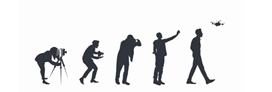
Through the presentation I was able to learn and the difference between the production of film making then and film making now. We were shown a picture defines the main different between then and now and the difference is in the technology. Photography in the 1800s was very hard as they weren’t as portable. You would have needed a lot of equipment to take a picture and it wasn’t even in colour. However, over many generations, cameras have become smaller and more portable to the point where we can carry them in our pockets as they are now automatically equipped on our phones, tablets and computers.
This also meant that the process of filming and publishing a film in the 1800s was very difficult as their equipment wasn’t as good as they are now. This meant that:
However, till this day some organisations still use low budget methods by using everyday items such as bags to hold the camera /handheld camera instead of stabilisers. This method was used a rebellion against Hollywood.
What I did
First lesson was and introducing to our course. Our teacher was explaining:
Learning Outcomes:
1) Identify a range of media production techniques in radio, audio production, online
video, and television.
2) Demonstrate basic media production skills in radio, audio production, online video and
television.
3) Utilise basic media production skills to produce your own creative work in response to
briefs.
4) Demonstrate commitment to own learning and engagement with course content
What I learnt in lesson
In the lesson we started for the basics. The first thing was to break down and understand the meaning of ‘Media’.
Class definition
‘Linguistically, ‘media’ is the plural of medium. A medium refers at base to one thing between two others. Our usage reflects a conception of a medium of communication as being a conduit through which messages are channelled.’ (Long and Wall, 2012: 3)
My definition of media is the being able to showcase messages through more than one platform in different ways.
Media is split in 3 ways:
I was then asked to create a spider diagram of all the different types of media that I have engaged with so far. This is my diagram.

About Me
Hi, my name is Glen Falanka and I am an 18 year old born and raised in South London who is now studying Media Production at Birmingham City University. In my spare time I do art and produce beats. Before making my decision to come to university, I was a sixth form student studying Fine Art, Business and Media Studies. I never did media in GCSE however decided to give it a try as it was either that or History (which is boring) and instantly grew to like the subject. His lead me to go to Birmingham city university for two reasons.
What I Hope to Gain
What I hope to gain in the course is a better understand of the media industry as want to turn my talents into passion. This will give me a better understanding of how to get in the media industry and work it works in different platforms such as TV and radio. As media production cover all parts of media this would enable me to enjoy my subject more as I would be learning different things which would also make my chances going into the media industry easier as I would have a good understanding with each platform.
Ready to start and ready to learn.

 Glen's Blog